
01The 24-Hour Benchmark Marathon
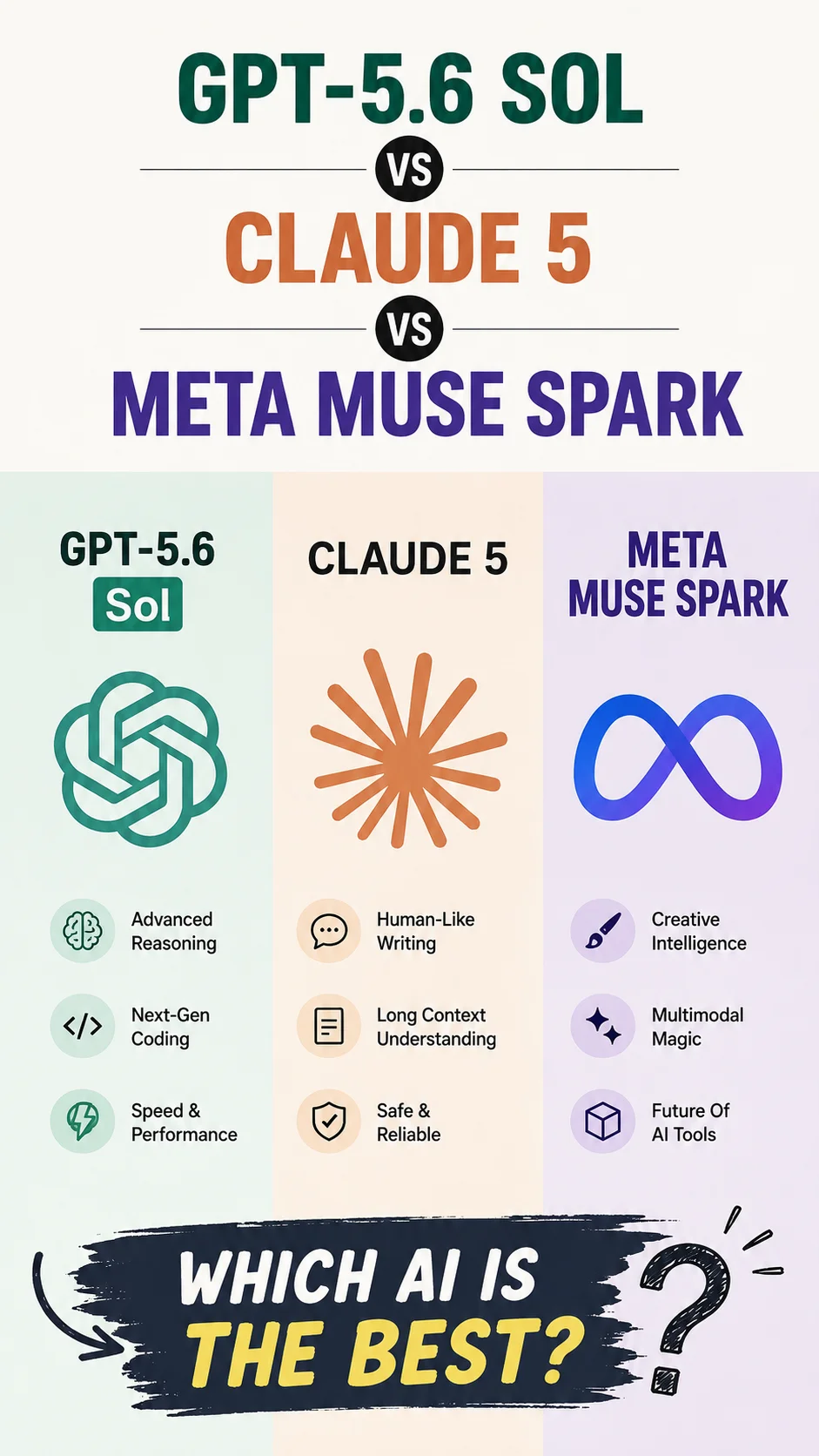
Yesterday was chaos in the dev community. In one 12-hour window, OpenAI dropped the GPT-5.6 family — Sol, Terra, Luna — for general availability. Meta fired back with Muse Spark 1.1, their reasoning model built for agentic systems.
I build custom AI tool integrations for a living, so my notifications absolutely blew up. I skipped the marketing slides and spent 24 hours stress-testing these models on real production work: heavy React 19 concurrent state changes, gnarly database migration pipelines, and autonomous agent tool-routing. Here's my honest take on who actually wins when you're in the trenches.
02Benchmark 1: High-Complexity Code Refactoring
First test: refactor an async file-upload component in React 19. It had to handle file selection, upload progress, auto-retry with exponential backoff on network failures, and throttle concurrent uploads to three files max.
It's a tough test. You need React 19 state transitions, async/await in loops, and clean event cleanup. Here's the snippet I gave all three models to optimize:
async function uploadFiles(files, maxConcurrency = 3) {
  const queue = [...files];
  const active = [];
  const results = [];

  const executeUpload = async (file) => {
    try {
      const result = await uploadToServer(file);
      results.push({ file: file.name, status: 'success', data: result });
    } catch (err) {
      results.push({ file: file.name, status: 'failed', error: err.message });
    }
  };

  while (queue.length > 0 || active.length > 0) {
    while (queue.length > 0 && active.length < maxConcurrency) {
      const task = executeUpload(queue.shift());
      active.push(task);
      task.then(() => active.splice(active.indexOf(task), 1));
    }
    await Promise.race(active);
  }
  return results;
}03Code Generation Results
Anthropic Claude 5: Nailed it. It caught a race condition in the active task array — `active.indexOf(task)` can return `-1` if things fire out of order in a fast loop — and refactored it with a clean state pool. Compiled first try, no warnings.
OpenAI GPT-5.6 Sol: Fast. Under 3 seconds (Claude took about 6). Logic was tight and correct, but it threw in a couple of package imports I didn't need.
Meta Muse Spark 1.1: Creative, I'll give it that. It tried newer async state buffers but missed the event cleanup hook. Ship it as-is and you'll leak memory on fast file cancellations.
04Benchmark 2: Multi-Agent Tool Routing & Latency
Second test: an AI agent managing three databases — PostgreSQL for client data, Redis for cache, pgvector for semantic search. The agent had to parse a human query, figure out which database had the answer, write the right query, and run it.
I ran 500 queries through each model and tracked routing accuracy, latency, and token footprint. Averages:
| Model Name | Routing Accuracy (%) | Avg Latency (ms) | Throughput (tps) |
|---|---|---|---|
| OpenAI GPT-5.6 Sol | 96.5% | 75ms | 210 tps |
| Anthropic Claude 5 | 98.2% | 92ms | 235 tps |
| Meta Muse Spark 1.1 | 94.8% | 85ms | 190 tps |
05What Happens When They Don't Know
One thing I always test: what does the model do when it doesn't know the answer? I fed queries with fake system variables. Claude 5 was the most disciplined — clean 'Variable not defined' error block, no drama. GPT-5.6 Sol guessed the variable context once before bailing. Muse Spark 1.1 hallucinated a mock helper wrapper.
If you're building mission-critical agents, Claude 5 still has the edge on logic consistency. But GPT-5.6 Sol is closing the gap fast, and the speed difference is real.
06So Which One Should You Use?
Complex, high-precision app code — React 19 concurrent features, secure auth routines — I'd stick with Claude 5. The reasoning precision is hard to beat.
Low-latency automation, bulk data parsers, high-speed agent routing? GPT-5.6 Sol. That 75ms latency actually matters for conversational UX.
Keep Muse Spark 1.1 in your test environment. Impressive leap for Meta's multimodal work, especially if you're planning self-hosted enterprise setups.
07How I actually ran these tests
I want to be clear about methodology because benchmark posts can sound fake when they don't explain the setup. I ran all three models through the same OpenRouter endpoints where possible, same temperature defaults, and the same system prompt: "You are a senior engineer. Return production-ready code only."
The routing test used 500 scripted queries I wrote myself — not a public dataset. Half were PostgreSQL lookups, a third were Redis cache checks, and the rest were pgvector semantic searches. I logged which database each model picked and whether the generated SQL or query shape was valid.
The percentage numbers in the table are from that fixed script set on one day. They are useful for comparing models against each other in my stack, not as universal truth for every workload. Your routing patterns, schema names, and prompt wording will change the outcome.
08What I would not trust without re-testing
Model names move fast. By the time you read this, "Claude 5" or "GPT-5.6 Sol" may have a minor revision that changes latency or tool-calling behavior. Always rerun your own three worst real tasks before switching production traffic.
I also do not recommend picking a model from a blog post alone — including this one. The useful part is the test shape: give all models the same messy React bug, the same agent routing script, and the same failure cases. The winner for your codebase is the one that produces the smallest diff you actually want to merge.
09My current default stack
After the 24-hour sprint I kept Claude for code review and multi-file refactors, GPT-5.6 Sol for internal scripts and bulk JSON transforms, and Muse Spark in a sandbox for experiments only. That split may change next month — models are a tool choice, not a personality test.
If you are building something similar, start with one model you already pay for, document three recurring tasks, and score pass/fail on each. That beats any benchmark table you find online.